
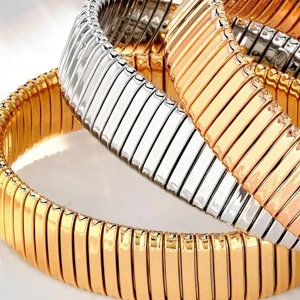
Credit: Tessitore 1888
Tubogas is having yet another moment. Once a niche, insider term mostly known to fashion editors and stylists, the Tubogas bracelet is showing up on the wrist stacks of both jewelry influencers and vintage collectors. It’s prized for its flexibility and wearability in ways that few other gold techniques can match.
Tubogas has stood the test of time. It seems that each generation of jeweler that falls in love with this curious flexible tube wants to add their interpretation and make it their own.
"Sometimes the problem is that young designers sell things that they may have actually conceived, but that others had already produced before them." ~ Enrico Tessitore, Tessitore 1888
What follows is the history of Tubogas: the facts, the stories, and a timeline, all in one place.
What is Tubogas? The Anatomy of Tubogas
Tubogas bracelets, necklaces, and rings are made from narrow strips of gold. The strips are coiled and interlock without solder, so the finished piece is flexible and moves almost like liquid metal while still holding its shape.
Tubogas is the Italian word for gas tube, which is the inspiration for this truly unique jewelry design. And while Bulgari, Italy’s high jewelry house, is probably the most famous creator of Tubogas jewelry, it was not in fact the inventor.
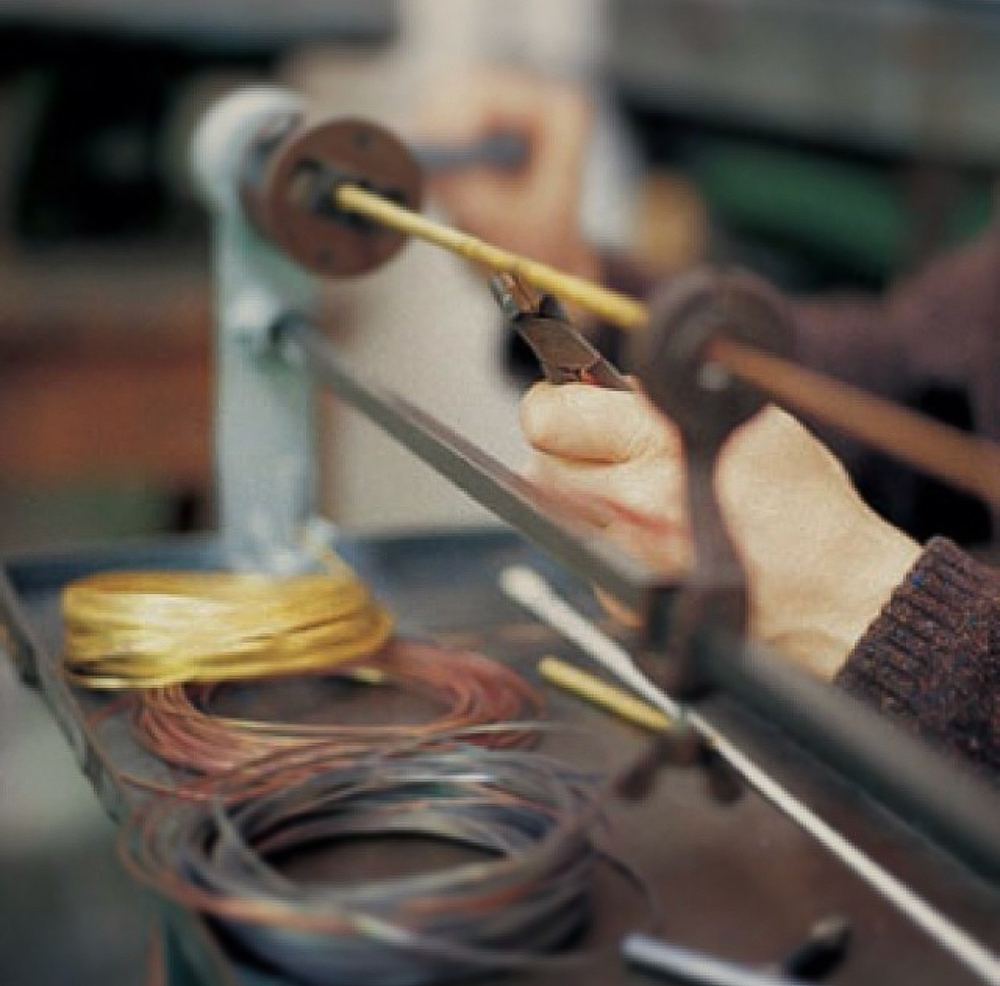
I met the two generations of the Tessitore family: Enrico Tessitore (the fourth generation) and Andrea Tessitore (the fifth generation) while searching for Tubogas jewelry at VicenzaOro earlier this year. Tessitore 1888, is a fine jewelry atelier with a Naples workshop where they have been making Tubogas by hand since the 1930's. They explained how Tubogas is handcrafted.
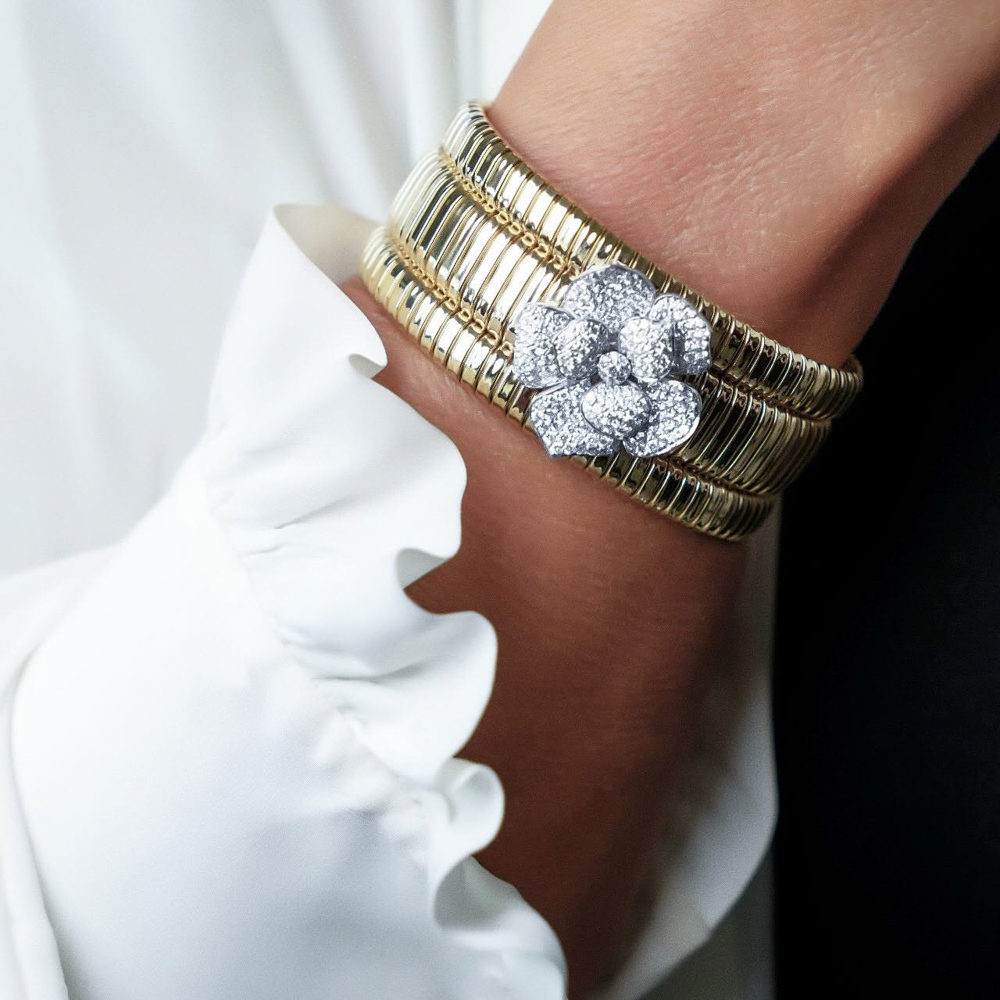
Credit: Tessitore 1888
“The process is entirely artisanal and consists of cutting long wires of gold, silver or other metal from sheets, these wires are then passed through a die that makes them U-shaped, but with right angles. Then two of these wires are coupled (one U and the other upside down by fitting one of the profiles into the other); thus coupled they are made to rotate around a form (of wood, steel or wax) until the necessary length without ever leaving the two ends. The gas pipe tubing is ready to take on the desired shape and to be modified according to needs.“
Who Made Tubogas Famous? The Bulgari Factor
One cannot write about Tubogas and its history without featuring Bulgari. Their significant investment over the past 78 years in craftsmanship and marketing has elevated Tubogas to the world stage, turning it into one of jewelry's most coveted pieces.
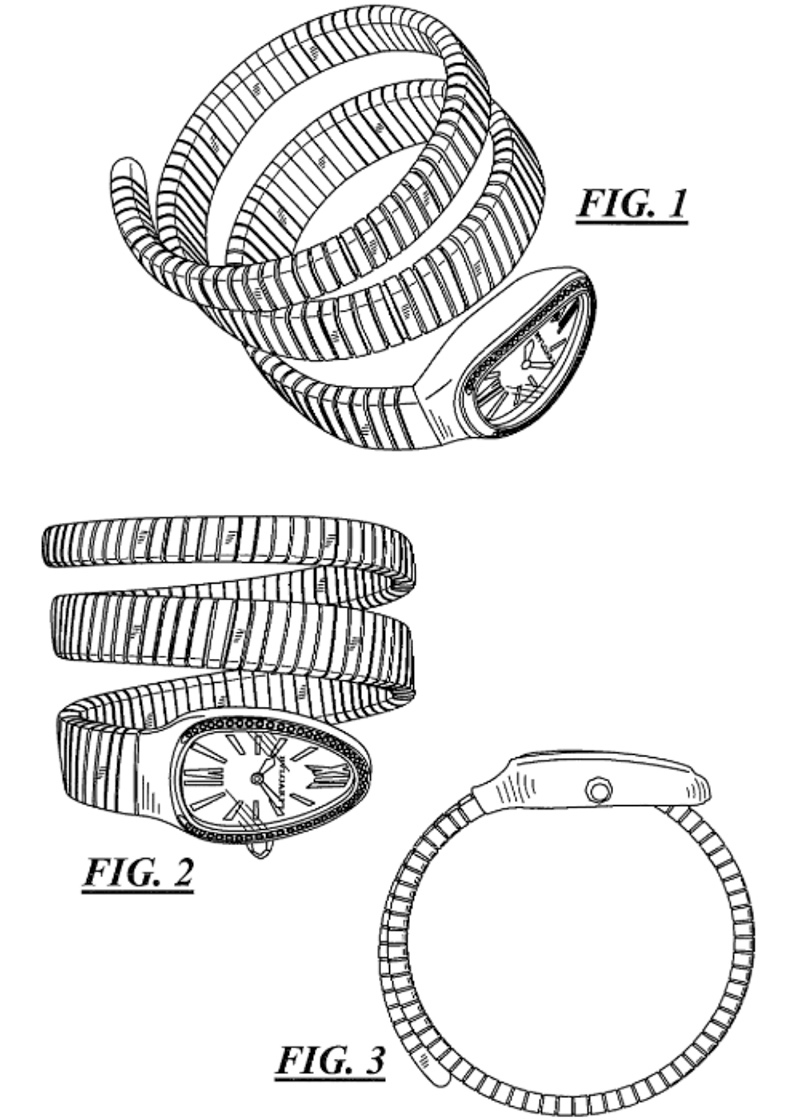
Credit: Google Patents, USD628092S1 (design patent granted 11/30/2010 "The ornamental design for a watch")
The gold ribbing, a prominent feature of Tubogas, is a natural fit for their Serpenti line. Introduced in 1948 as a bracelet watch that wraps around the wrist, it has evolved into expansive line for Bulgari. The snake motif has captivated jewelry lovers for centuries, worn by Cleopatra in Ancient Egypt, embraced by the Georgians in 18th-century England, and still beloved today.
Fashion illuminati and celebrities have helped the Roman Jewelry house expand its popularity. British Vogue credits the 1962 publicity photo of Elizabeth Taylor wearing a coiled gold and diamond snake bracelet-watch on the set of Cleopatra for catapulting Bulgari's Serpenti to international fame.
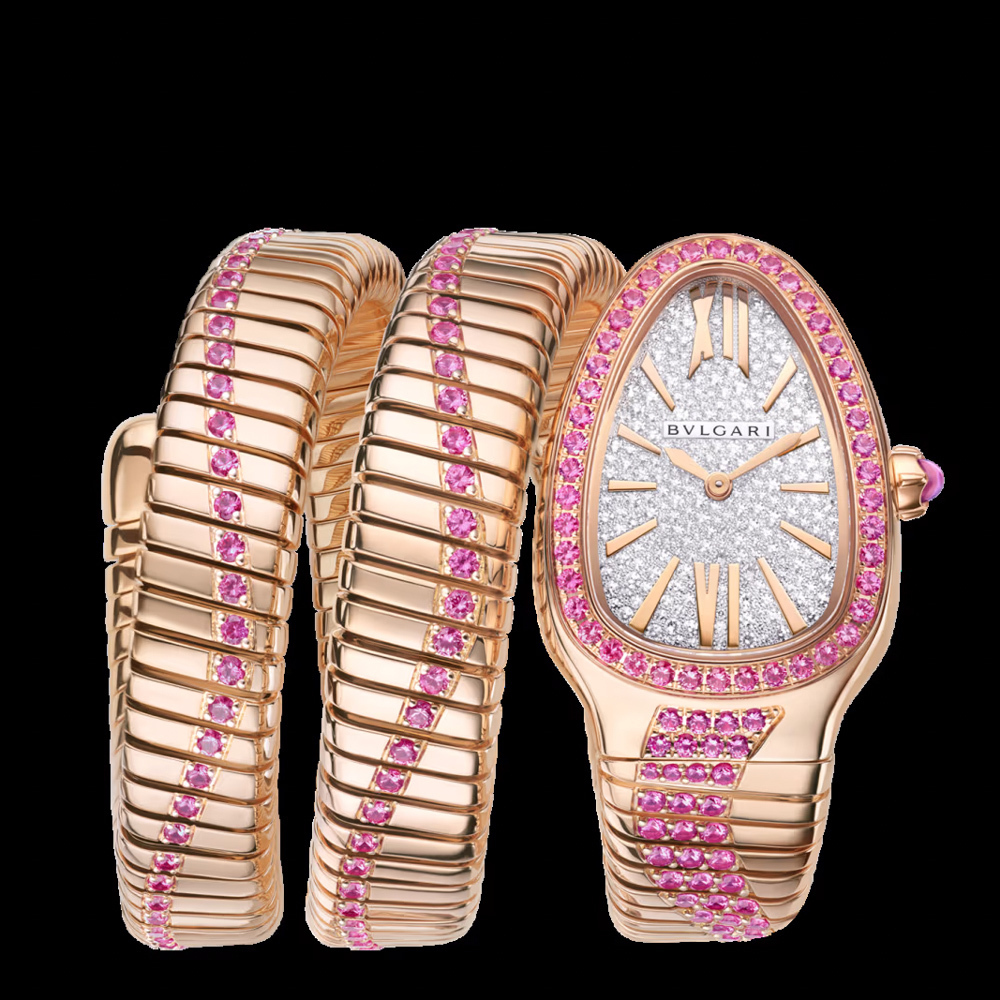
The Bulgari Tubogas goes well beyond the Serpenti collection. Bulgari devotees love everything from the classic tubular choker, to bracelets with various diamond and gemstone embellishments to the simple and classic Tubogas gold bracelet.
How has Tubogas Construction Changed Over Time
Artisans that make Tubogas by hand, make Tubogas necklaces and bracelets in a similar way. The process startw with two U-shaped profiled wires, a male and a female, which are wound around a steel mandrel depending on the desired shape. A series of annealing processes over an open flame allows the mandrel to be removed, giving the tubogas the elasticity it needs. Tubogas, therefore, is always hollow inside.
Bracelets, which require the ability to be adjusted, and flex when taken on and off require one extra step. After the coil is completed a spring, also called a blade, is inserted into the hollow space inside of the core.
Orignally, the spring was made of raw white gold. 1980 marked a time of change for not only for this process, but the entire jewelry industry. In January of 1980, gold peaked at $850 per ounce, more than tripling in a span of 12 months. Steel springs were introduced, replacing the springs that were previously made of gold. (Source: Carlophilippo Weingrill)
Credit: Carlo Weingrill
In recent years, Bulgari has reported a change to Titanium in some of its products. There seem to be different shools of thought on the use of Titanium and Bulgari seems to be the only one I could verify that is using it. While it is lighter, the spring mechanism may work too well. It has the potential to work too well making it more challenging when trying to mould the bracelet to one's wrist.
At LVMH’s 2023 Watch Week Bulgari announced "For the first time, the serpentine silhouette continues from the watch case all the way to the bracelet, thanks to refined gemsetting adorning a modular construction. The rings are moulded – each in unique dimensions – before being polished, gem-set and assembled on a titanium blade." Bulgari also separately confirmed the use of a titanium blade in an email to me (March 2026) discussing their iconic Tubogas bracelet indicating that it has "an additional 3.9 grams of titanium is inside the bracelet to provide flexibility."
Evaluating Tubogas: Understanding the Difference Between Machine Made and Hand-Crafted
“Only 20 People in the World Know Its Manufacturing Secrets” This is what Lucia Silvestri, Bulgari Executive Creative Director told France’s Le Figaro Style in November 2024. In Paris for Bulgari’s latest launch she added “few artisans in the world know how to roll up, without welding, this flexible tubular shape born in the 19th century.”
This is consistent with Enrico Tessitore description of the few companies that still handcraft Tubogas. “Only in Naples (Tessitore1888), Verona (Carlo Weingrill 1879) and Florence there are some companies that still produce Tubogas the old way, handmade, thanks to the know-how of the few skilled artists and artisans left.”
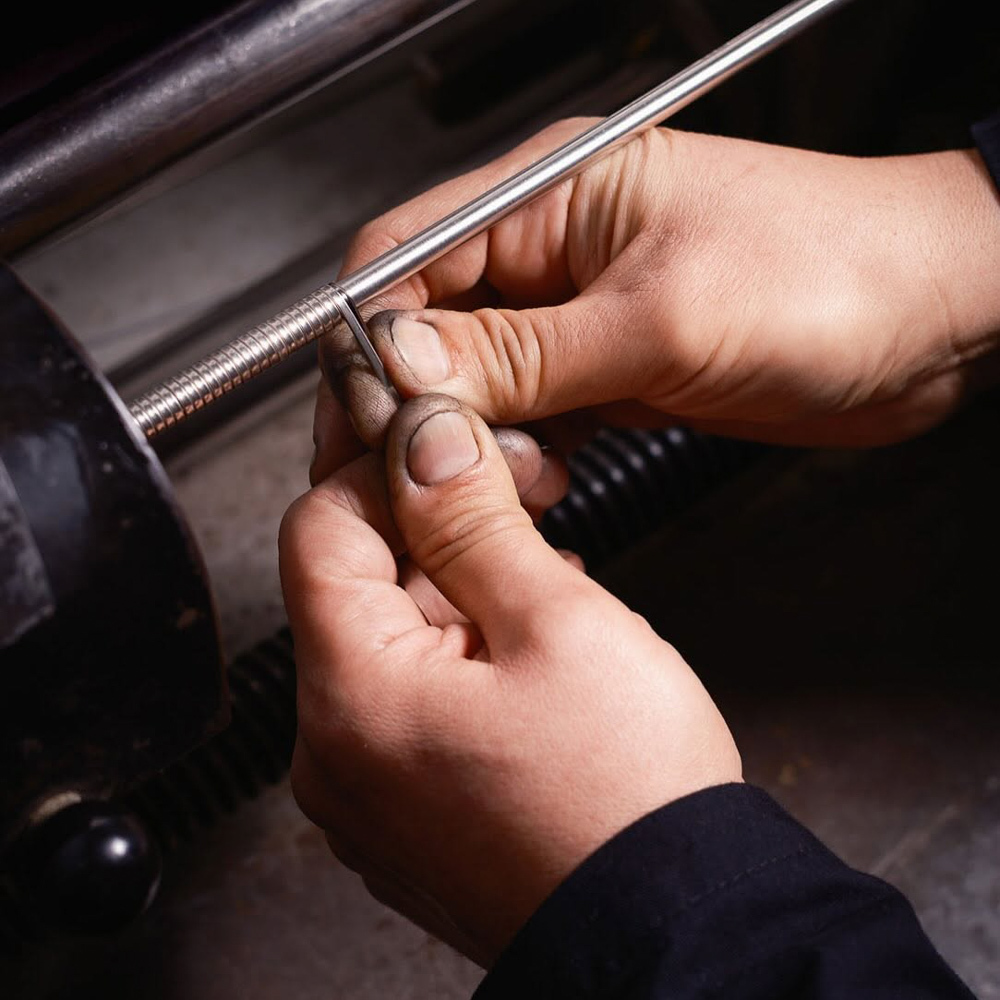
Credit: Tessitore 1888
During my discussion with the Tessitore family, when asked about Tubogas’s current popularity they further explained that with its popularity has come expansion. “For some years now, with the advent of industrial machines, there has been greater availability of the product, but this does not mean that it can ever be compared to the traditional artisanal craftsmanship of the past, which only very few companies know how to produce. Their product, being machine-made, is of a lower quality and cheaper. The quality of our product is unique and can't be reproduced anywhere else.”
To the untrained eye, it can be difficult to spot the details that can help you tell difference between handmade piece of Tubogas jewelry and one that is machine made. There are the things you can see and the things you can’t.
You can see the overall quality of a handmade piece, but it’s more of an impression than a measurement. You can feel the craftsmanship in the flex of the coil and the way it molds to your body. This comes from the years of training and skill that become part of the piece during its construction.
This especially matters when you buy something online and can’t touch the piece. A maker’s mark takes the guess work out of the equation, if you know which companies have been producing Tubogas by hand for decades.
Where Can You Buy Authentic, Hand-Made Tubogas Jewelry?
Directly from the makers: Bulgari, Tessitore 1888, Carlo Weingrill, or through their retailers.
Credit: Carlo Weingrill
This is not meant to be an exhaustive or definitive list, but the following highlights some of the remaining artisans that still create this type of jewelry by hand.
Bulgari: The most famous name in Tubogas jewelry. You can purchase both online and in boutique. The have bracelets, watches, necklaces, and rings. Their current offering of Tubogas bracelets include:
Three simple gold versions, four with diamond details, and four with precious colored gems.
Thirty-seven Serpenti Tubogas Watch models (they wrap around the wrist).
Two Serpenti Tubogas Bracelets. Note that they also have other bracelets in the Serpenti line, that have flexibility, but they are not Tubogas.
Tessitore 1888: They recently launched an update to their own site, though it's still being built out (bracelets weren't showing at the time of writing). Their instagram account shows more of their offerings. You can purchase some pieces directly from them or feel free to contact us to facilitate your order from Italy.
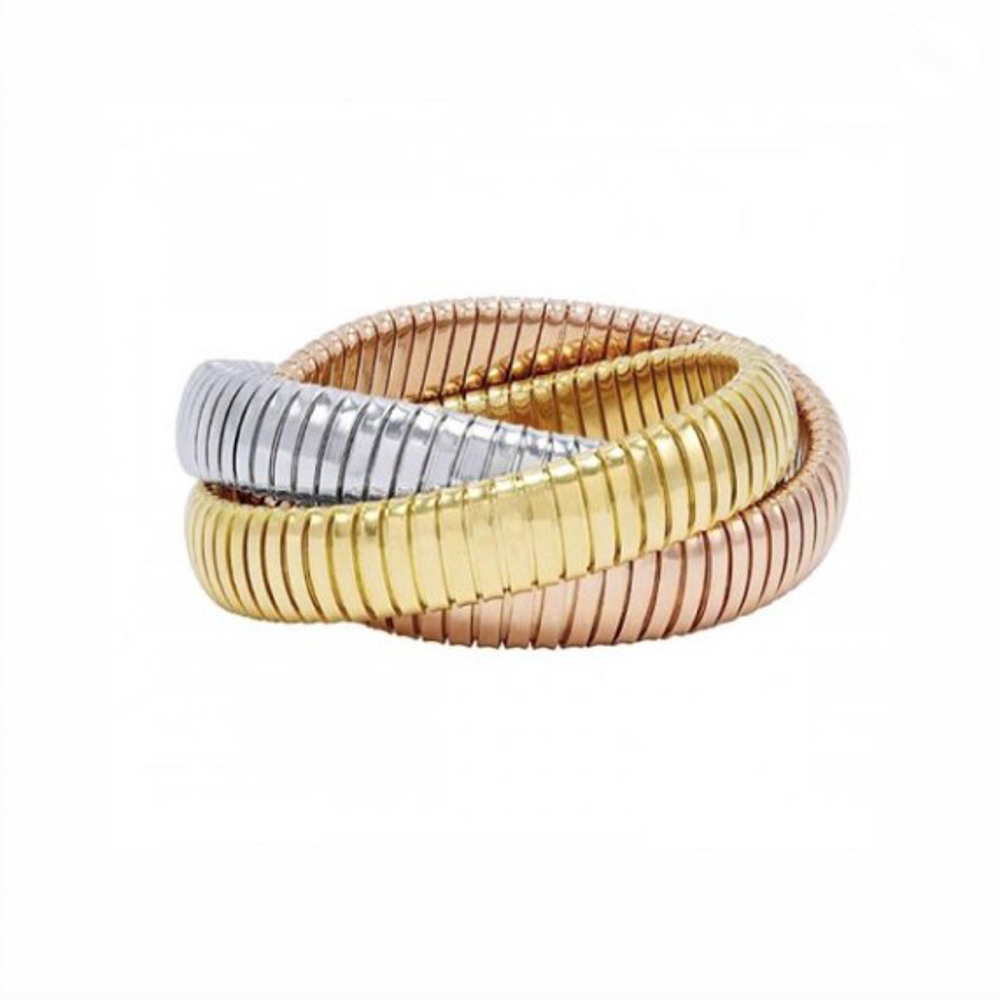
Carlo Weingrill: A Verona-based workshop, with a rich and storied history. They do not have a physical boutique. You can purchase from them directly online or through a select group of luxury retailers. The are most famous for their rolling bracelet which looks like three bracelets entwined together. They have a variety single cuffs in multiple widths.
Sugar et Cie: We carry the Tessitore 1888 sapphire and diamond tubogas bracelet featured on our site. We're also able to special order any other Tessitore piece directly.
How to Choose a Vintage Tubogas Bracelet
You can also find a variety of Tubogas jewelry through retailers and auction houses that carry vintage Tubogas jewelry. There are two important considerations when shopping for vintage. If you are interested in finding a piece that is handmade, look for the maker’s mark of a company you know (e.g. Bulgari, Tessitore 1888, Carlo Weingrill).
Another famous maker of handmade Tubogas is Van Cleef & Arpels. See the timeline below for details of their version. You can only buy vintage Van Cleef & Arpels as they no longer make this line of jewelry.
The other thing is to consider is the era of the piece and whether it is likely to include an internal blade (also called a spring) that will help the bracelet to continue to keep its shape. This is mostly a factor for bracelets or any piece that needs to stretch out and coil back when putting it on or taking it off. It is less important for necklaces.
Who Invented Tubogas Jewelry?
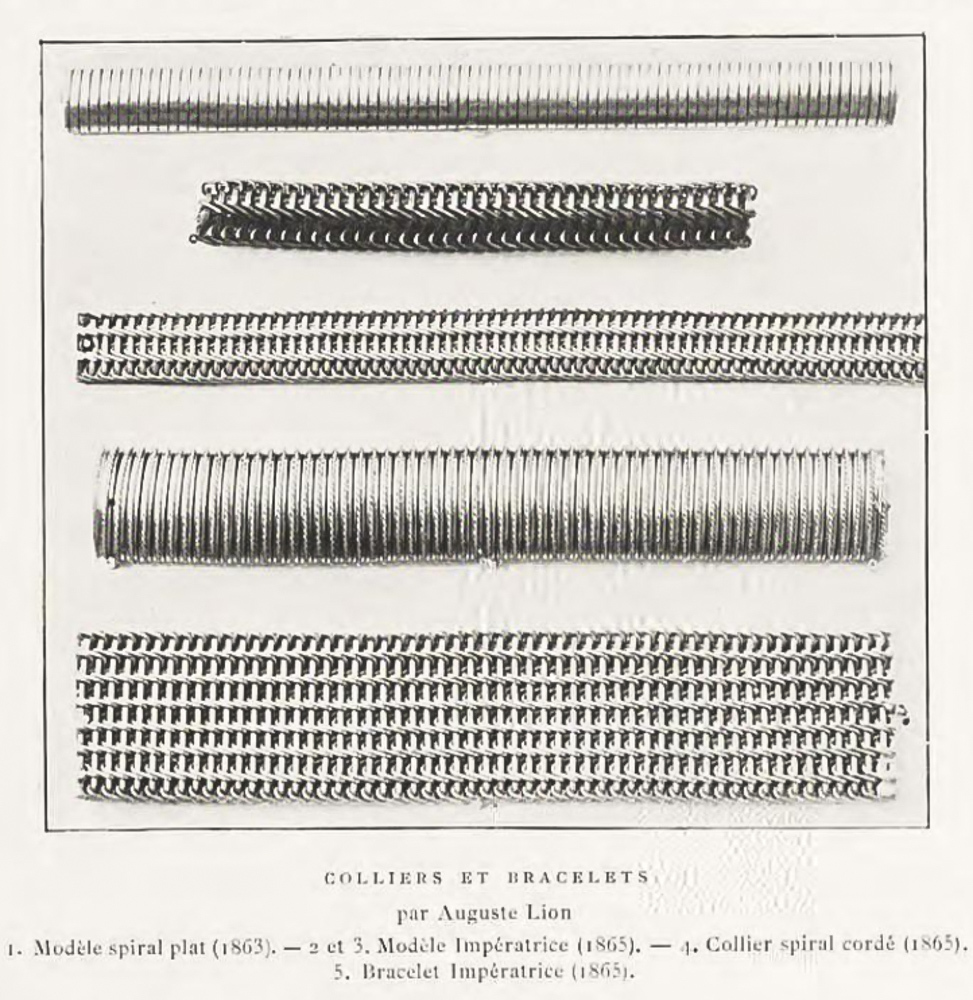
No single inventor is documented, but the earliest dated example I could find is Auguste Lion’s flat spiral necklace of 1863, illustrated by Henri Vever.
Credit: La Bijouterie Française au XIXe Siècle Henri Vever
Strangley, though the 1920's that is often referenced as the origin of Tubogas. However, it is more accurate to call it a period of a revival in the 20th century.
Gas tubes are frquently cited as the inspiration for Tubogas jewelry. A jeweler or goldsmith might have observed this type of flexible metal tubing (invented by Heinrich Witzenmann) in their own workshop. This kind of gas tubing could have, for example, fueled their kiln or furnace.
Tubogas has a long and storied past. From the jeweler’s bench to the factory floor, Tubogas has transformed itself from decorative gold adornment to industrial hardware...and back again as you'll see in the story that unfolds in the timeline.
The timeline I created is compiled from a variety of sources including books, company histories, interviews, and patent records.
Tubogas History: A Timeline
1854: Witzenmann, the future inventor of the flexible metal hose, enters the jewelry industry. He founds his jewelry firm in Pforzheim, Germany, with Louis Kuppenheim. Source: Witzenmann Group History.
1863-1865: Auguste Lion creates Tubogas style bracelets and necklaces, beginning with his “flat spiral” necklace of 1863 and followed by his “Empress” (Impératrice) models in 1865. Vever documents these early pieces with an image of both, attributed to Auguste Lion: “These chains were either woven or braided, or, and this was the great innovation, made with a gold wire about 1 millimeter wide, almost flat or in the shape of a gutter, which was wound into a continuous, tight spiral, like a coil spring, each turn fitting seamlessly into the previous one. This type of work, once finished, produced supple and sturdy necklaces that rather resembled flattened snakes, long ringed reptiles.” Source: Bijouterie Française au XIXe Siècle, vol. II, Henri Vever, p. 316 (translated from the French).
1867: 19th c. Tubogas reference. Henri Vever’s observations from the 1867 World Exhibition (Paris, France) about jewelry from chain manufacturers. “To speak of one example very popular today, used to suspend rich medallions, how can we understand the lightness, flexibility, and elasticity of the helical spiral chain and all of its derivatives are due solely to the combination of two gold rods lined with copper, rolled one on top of the other, which, freed from this copper by the action of acids, remain linked to each other without any riveting, without any welding? Is there anything simpler, or more ingenious that this combination.” Source: La Bijouterie Française au XIXe Siècle, vol. II, Henri Vever p. 314.
1877: Witzenmann expands to France. A second jewelry factory is established in Paris, with partner Eugène Levavasseur. Source: Witzenmann Group History.
1879: Weingrill founded. An early hand-fabricator of Tubogas, is founded in Verona, Italy. Source: Carlo Weingrill Company History.
1884: Bulgari founded in Rome. While not the first Jewelry House to offer Tubogas in the 20th century, it is the most well-known maker of Tubogas. Source: Bulgari company history.
1885: The industrial flexible metal hose is patented. Having left the jewelry industry for the industrial, Witzenmann and Levavasseur patent the flexible metal hose which is "based on the principle of the gooseneck chain". It is described as "Stripwound hoses are produced in a continuous process by profiling and helical coiling of a cold-rolled metal strip on a mandrel." Source: Witzenmann Group History and Witzenmann Products.
1888: Tessitore founded. An early innovator in Tubogas, founded in Naples. Source: Tessitore 1888.
1920s: Industrial gas tube is a visible part of everyday life. According to Bulgari this is the inspiration for 20th century Tubogas jewelry. "Sleek and flexible, the Tubogas motif was inspired by the shape of the gas carrier pipes in use from the 1920s onwards." Source: Bulgari.
1935: Tessitore launches Tubogas Jewelry. Tessitore begins specializing in Tubogas construction. Source: Tessitore interview.
1938-39: Van Cleef & Arpels patents the Passe-Partout, a transformable tubogas jewel with detachable gems and includes it at their the New York World's Fair exhibit. Source: Van Cleef & Arpels.
1948: Bulgari's Tubogas. Bulgari launches the first Serpenti bracelet-watch, pairing a spiraled Tubogas band with a geometric watch dial. Source: Bulgari company history.
1950s-1980s: New iconic designs. Weingrill creates the Choker Necklace and the Rolling bracelet (1985) which become iconic Tubogas designs of the period. Source: Interview with Tessitore and Carlofilippo Mensi Weingrill.
1962: International exposure. Elizabeth Taylor is photographed wearing the Bulgari Serpenti Tubogas bracelet watch on the film set of Cleopatra, giving Tubogas international media attention and increasing its popularity. Source: British Vogue.
1970s: Tubogas experinces a revival. Bulgari cites the 1970s as a time of revival for Tubogas: "This technique, developed during the second half of the nineteenth century, was revived by Bulgari in the 1970s, becoming one of the firm’s trademarks." Source: Bulgari.
2010: Bulgari Serpenti Tubogas design patent.
Paolo Bulgari is awarded a U.S. design patent for the ornamental design of a watch. The image depicted appears to be the Serpenti Tubogas Watch Bracelet. Source: US Patent Office Patent US D628092 S and Google Patents.
2023: The titanium blade. Bulgari discusses the innovation of inserting a titanium blade into a Tubogas bracelet at the 2023 LVMH Watch week.