
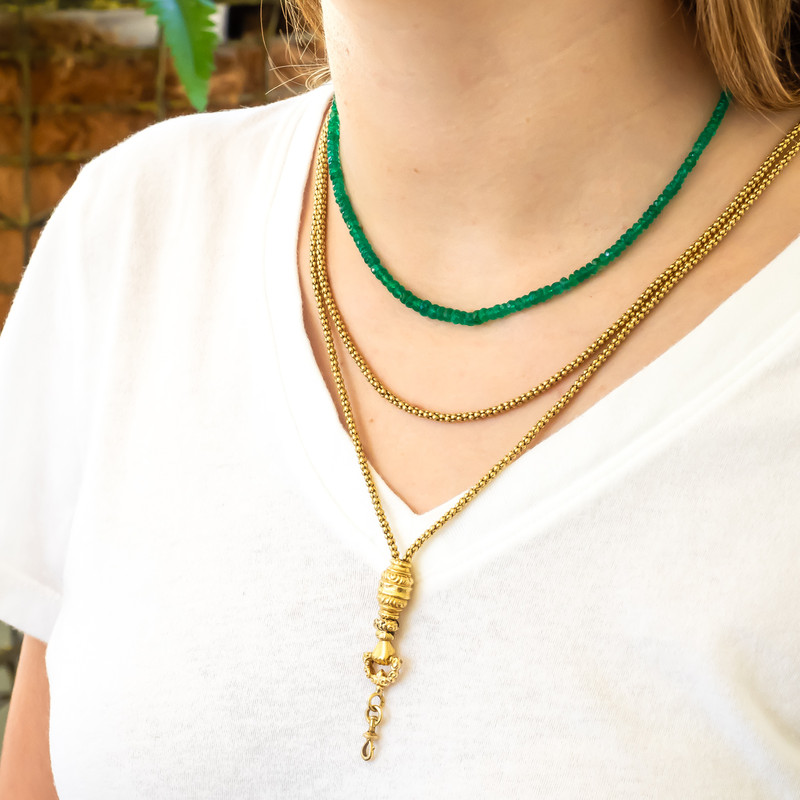
The Emerald Bead Necklace
A necklace strung with precious (or semi-precious) gemstones is one of those timeless investment pieces that never seem to go out of style.
But why oh why is it that some strands feel modern and fresh and others feel like they belong in your mom’s jewelry box?
Here are some tips to help you choose and seamlessly work a luscious strand of color into your necklace stack.
We've also included a combination checklist and Emerald Buying Guide FAQs to help you evaluate the quality, craftsmanship, and authenticity of an Emerald Bead Necklace.
Just Launched Our Limited Edition Emerald Bead Necklace:
We may be a bit biased, but we think Emeralds are an amazing way to add color to your necklace stack. We've just added this Emerald Bead Necklace to our necklace collection.
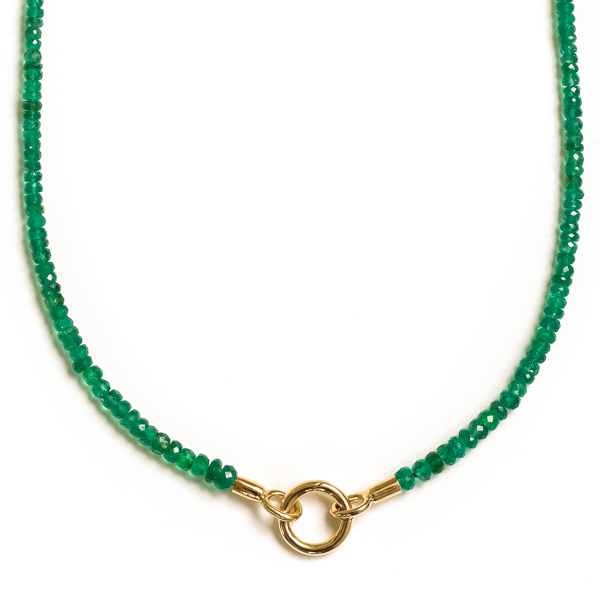
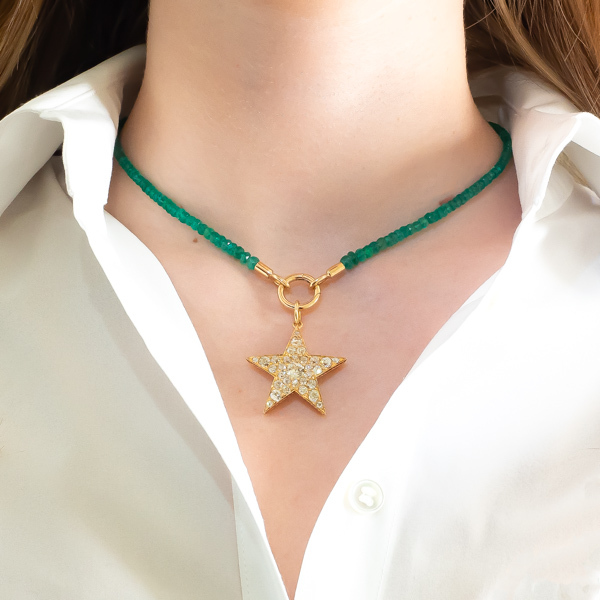
It is our own design and was goldsmithed in California. It is 40 carats of natural Emeralds from Colombia (GIA tested). It was specifically designed with our push-in Charm Holder in 14k. It can be worn with the charm holder in front if you want to layer in charms or in the back for an uninterruppted river of green.
© Copyright Sugar et Cie
© Copyright Sugar et Cie
Focus on the Color of the Emeralds
Did I mention the color? I think the most important thing you can do is choose a vibrant hue! All else being equal, color is the most important factor in value.
I love vibrant blues and greens in the spring and summer. Think Emeralds, bright blue Sapphires, or even Turquoise. These mix and stack beautifully with rich gold. Alternatively if you are a lover of white metal, mix in white gold/platinum and little bits of diamonds.
In the fall and winter choose vibrant purples and plums or reds and even a deep orange. You know "jammy colors". Rubies, amethysts, and garnets can be a bit deeper in hue, but they are still vibrant enough to add color to your stack.
Whatever you choose, make sure you pay attention to the quality. If you don’t, you are likely to end up with something that will end up in your box and not around your neck. A total waste of money.
I am actually astounded at times at the mediocre quality of the gemstones used by some of the branded designers. We’ve included a check-list of questions for you to use at the end just in case you’ve decided to add one of these beauties to your jewelry wish list (and we sell out of our limited edition).
Sparkle and Life
You can see the quality in the “life” of the gemstones. While they are not going to sparkle like a larger faceted stone set in a pendant or ring, they should have good color and some sparkle when they catch the light. Stones that are lower in quality and clarity will be washed out and lifeless.
Size and Shape of the Bead
A smaller to medium-sized, faceted round bead works the best as they are easier to mix in with your stack. The facet reflects the light and adds sparkle. I also like non-faceted or a smooth bead but in an oval shape. Larger round beads, that are not graduated in size, start to lean towards those that belong in the “Mom” category.
Length of the Necklace
Play around with the lengths that you already have and find a length that fills a gap for your stack. The shorter strand (15-17) is probably going to work the best. They bring the color closer to your face and are not as likely to get lost in the backdrop of your clothing.
The Style of the Clasp
Part of this depends upon whether you plan to wear the strand on its own or as part of your stack and your personal aesthetic.
A more elaborate clasp is better for a stand-alone strand with larger beads. A simpler clasp is better for a stack. Better yet is one that includes a charm holder as part of the clasp. This lends flexibility as it gives you multiple options. Wear it without a charm or pendant when you are in a minimalist mood. Add a charm or pendant when you are feeling a bit more maximalist.
As promised here is our checklist. I've noticed that carat weight and gold weight are often not included. If information you're interested in isn’t included in the description, you should feel free to ask. While this list is more tailored to a bead necklace you can use it for Emerald Jewelry in general. The one caveat is that it's not as applicable to strands at a lower price point.
Check List: Emerald Bead Necklace Buying Guide
Are the Emeralds Are Real?
If it is not explicitly stated, you should ask. Actually, what you want to ask is if the Emeralds are natural. It almost seems like you shouldn't have to ask, but the growth in production of lab diamonds has also sparked a growth in lab-grown, colored stones. There is nothing wrong with lab-grown, but it is important to know what you are buying.
Are the Emeralds Are Treated or Dyed?
Just because they are natural doesn't mean they haven't been treated. For each colored stone you are considering purchasing, it is good to have a basic understanding of what kind of treatments are accepted, how pervasive they are, and how they impact value.
According to the GIA, based upon estimates gathered from the trade, more than 90% of Emeralds on the market have some sort of clarity enhancing treatment. (Gemological Institute of America, Chapter 15 Colored Stones, Emerald. 2004.)
Unless the price point is very high, expect to receive an answer that they have been treated with oil or resin. The majority of Emeralds have inclusions and clarity enhancement treatments. It is a generally accepted (e.g. oil, resin) practice. Dye is not.
What is the Emerald's Country of Origin?
Not every seller will know the origin of the Emerald. That is perfectly acceptable. If they do state an origin, consider asking them how they know and if a Gemological Report is available. Don’t expect a report for a strand at a lower price point. If at a higher price point, it is not an unreasonable request. Be sure to factor in the reputation of the lab when looking at the report. The GIA is the leader in the U.S., but there are other reputable Labs in other countries.
Today most Emeralds are sourced from Colombia, Zambia and Brazil. Emeralds from Colombia are generally considered to be the most sought after for their overall quality and more specifically their color. If you are looking at group of Emeralds that are equal in color, clarity, carat weight, and cut (i.e. all else is equal) the one from Colombia will be the most valuable.
If you’d like to learn more about Emeralds, visit GIA's Emerald Gemstone Page for more in depth information on Emerald treatments, quality factors, and the latest discoveries.
What is the Carat Weight of the Emerald Necklace?
While weight of the stone is not the only consideration, it is a factor and it is a basic piece of information that should be stated.
What Stringing Material was Used?
Silk thread is perfectly acceptable and is the go-to for beads that are knotted in between e.g. pearls or coral. The downside is that the sharpness of precious stone can sometimes rub on the thread and silk thread can stretch over time. Wire is extremely strong, will not stretch, cannot be cut into by a sharp edge on the inside of a drill hole, and doesn't stretch over time.
What is the clasp made from? Is it gold or platinum? What is the purity? What is the weight of the clasp?
Again, this seems like basic information, but it is also information that is not always shared. With precious metal prices at all time highs, it is nice to know and factors into the value.
What to Look For When Evaluating an Emerald
There is no universally agreed upon system for evaluating colored stones. GIA tends to use the 4 Cs as it does with diamonds, although the standards are applied a bit differently depending upon the type of gemstone that is being evaluated.
Some dealers have made up their own. You might see something rated using "AAAA" or "AAA". It is not an industry recognized system.
Color
Look for richly saturated green Emeralds with a vibrant color that is neither too dark nor too light. Emeralds from Brazil are often light in color and lack vibrancy.
Clarity & Transparency
Perfect clarity is rare in Emeralds, but avoid beads that appear lifeless or display visible black or brown inclusions that detract from the beauty of the strand.
Emerald beads should have some transparency. They should not appear opaque or resemble green Jade or Malachite.
Carat
I can't emphasize this enough, all else being equal, the greater the carat(s) the greater the value. Something larger or heavier of poor quality may very well be significantly less valuable than a smaller bead that is crafted from higher quality material.
Cut
In a round or oval bead, look for uniformity. In a faceted bead it is harder to tell, but the better the cut the better the sparkle.